

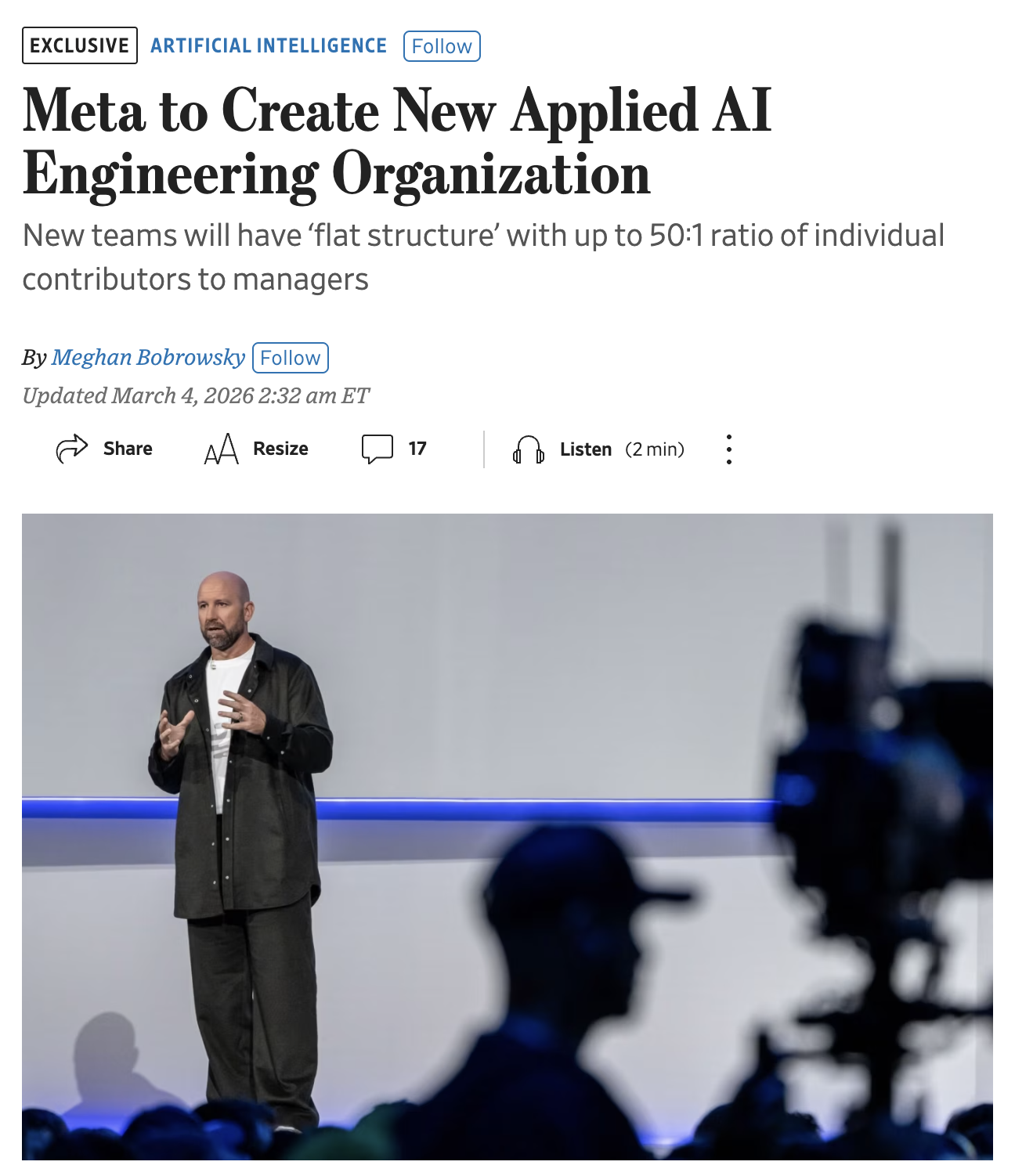
In today’s shocker, Meta is to “create a new applied AI engineering organization aiming for an ultra-flat structure of up to 50 employees to one manager”.
Like all software engineers I, too, tend to apply a data‑driven, mathematical approach to every problem in the world. Yet I would have chosen a more romantic number and applied the golden ratio: roughly 1.6:1, the proportion that shows up in seashells, galaxies, and every second slide about “natural elegance”, rather than 50:1, a measure that feels less like harmony and more like a spreadsheet’s idea of efficiency.
The idea of flattening an organization is not new and can be a good one. I know plenty of managers who have not done any individual contributor work, code or otherwise, in years. This is particularly striking with former strong coders who are promoted to managerial roles. After 2–3 cycles of promotions they are so far detached from what’s happening at the individual‑contributor level that they become 100% overhead, spending their entire life in meetings and actively preventing real work from being done. It’s natural to want to eliminate layers of such people as they simply don’t have any impact. And so, the real news at Meta is that it’s fighting its own organization design in which, at least in some teams according to my friends who work or have worked there, people managers are discouraged from doing deep technical work, don’t own much beyond process, and mostly serve as reporting‑structure placeholders.
Another reason to flatten an organization is the introduction of AI assistants that have created a major shift in the capabilities of individual contributors. Two years ago you could maybe find one single “10x engineer” in every team—someone who has dramatically higher velocity than their peers. A good manager would recognize these extraordinary abilities, make such an individual their right hand and technical partner, share the responsibility of advancing a project, create effective mentorship, and help bring the rest of the team along, distributing work in ways that optimize for the long term where juniors are grown slowly and incrementally. But with AI every engineer can—and in fact must—become a 10x engineer, fast. It therefore makes sense for a flagship AI team to hire already experienced, top‑1% engineers and not bother with juniors, thus requiring fewer managers.
The role of the manager must continue to evolve, but it has fundamentally not changed in my opinion. It remains critically important for any level of manager to be a role model and to deliver results. In a healthy team a manager has time to do some individual‑contributor work, and that is my favorite kind of manager. Today, this could mean using AI assistants to write some code. Beyond that, a manager’s job is to take ownership, articulate a vision and mission, disambiguate and provide clarity to their team, work with customers, recognize and show people what they are capable of, enable human aspirations, and take responsibility for shortcomings. If a manager does “real work”, it matters less how many people report to them; we want a team sized to the problem we are trying to solve, to create the right kind of focus, rather than to enforce a ratio.
An organization is just a tool to delineate responsibilities and provide clarity of purpose to groups of people. When we begin adjusting ratios, we forget that we are working with humans, and that like all metrics, the number is not the goal.